

Resurrected Ancestral Cannabis Enzymes Unveil the Origin and Functional Evolution of Cannabinoid Synthases
Source / Quelle: https://onlinelibrary.wiley.com/doi/10.1111/pbi.70475
ABSTRACT
Cannabinoids, such as tetrahydrocannabinolic acid (THCA), cannabidiolic acid (CBDA) and cannabichromenic acid (CBCA), are bioactive and medicinally relevant compounds found in the cannabis plant (Cannabis sativa L.). These three compounds are synthesised from a single precursor, cannabigerolic acid (CBGA), through regioselective reactions catalysed by different cannabinoid oxidocyclase enzymes. Despite the importance of cannabinoid oxidocyclases for determining cannabis chemotype and properties, the functional evolution and molecular mechanism of this enzyme family remain poorly understood. To address this gap, we combined ancestral sequence reconstruction and heterologous expression to resurrect and functionally characterise three ancestral cannabinoid oxidocyclases. Results showed that the ability to metabolise CBGA originated in a recent ancestor of cannabis and that early cannabinoid oxidocyclases were promiscuous enzymes producing all three THCA, CBDA and CBCA. Gene duplication and diversification later facilitated enzyme subfunctionalisation, leading to extant, highly-specialised THCA and CBDA synthases. Through rational engineering of these ancestors, we designed hybrid enzymes which allowed identifying key amino acid mutations underlying the functional evolution of cannabinoid oxidocyclases. Ancestral and hybrid enzymes also displayed unique activities and proved to be easier to produce heterologously than their extant counterparts. Overall, this study contributes to understanding the origin, evolution and molecular mechanism of cannabinoid oxidocyclases, which opens new perspectives for breeding, biotechnological and medicinal applications.
1 Introduction
Cannabinoids are specialised metabolites produced by the plant Cannabis sativa L. (cannabis). The most abundant and well-studied cannabinoids are (−)-trans-Δ9-tetrahydrocannabinol (THC) and cannabidiol (CBD). THC is primarily responsible for cannabis psychotropic effects, but it can also alleviate chronic pain, inflammation and nausea (Costa 2007; Jeddi et al. 2024). Contrarily, CBD is non-psychotropic and exhibits therapeutic potential in managing anxiety, depression and epilepsy (Aderinto et al. 2024; Han et al. 2024). Over 120 other cannabinoids have been identified in cannabis, including cannabichromene (CBC), which may contribute to neuroprotection and modulating inflammation (Stone et al. 2020; Cammà et al. 2025). Given their medicinal relevance, the biosynthetic pathway of THCA, CBDA and CBCA has been fully elucidated and associated biosynthetic genes were identified (Figure 1a). Briefly, cannabinoid biosynthesis begins with the formation of olivetolic acid (Taura et al. 2009; Stout et al. 2012; Gagne et al. 2012) and its prenylation into cannabigerolic acid (CBGA) (Fellermeier and Zenk 1998; Luo et al. 2019). CBGA is then converted into (−)-trans-Δ9-tetrahydrocannabinolic acid (THCA), cannabidiolic acid (CBDA), or cannabichromenic acid (CBCA) by regioselective cannabinoid oxidocyclases named THCA synthase (THCA) (Taura et al. 1995; Sirikantaramas et al. 2004), CBDA synthase (CBDAS) (Taura et al. 1996, 2007) and CBCA synthase (CBCAS) (Morimoto et al. 1998; Laverty et al. 2019), based on their main product selectivity. Resulting cannabinoid acids can then undergo nonenzymatic decarboxylation (e.g., via heat exposure) to yield their neutral counterparts (Figure 1a). Due to the regioselectivity of cannabinoid oxidocyclase enzymes, the presence/absence and relative expression of associated genes control cannabis chemotype and therapeutic potential (Gülck and Møller 2020).
FIGURE 1
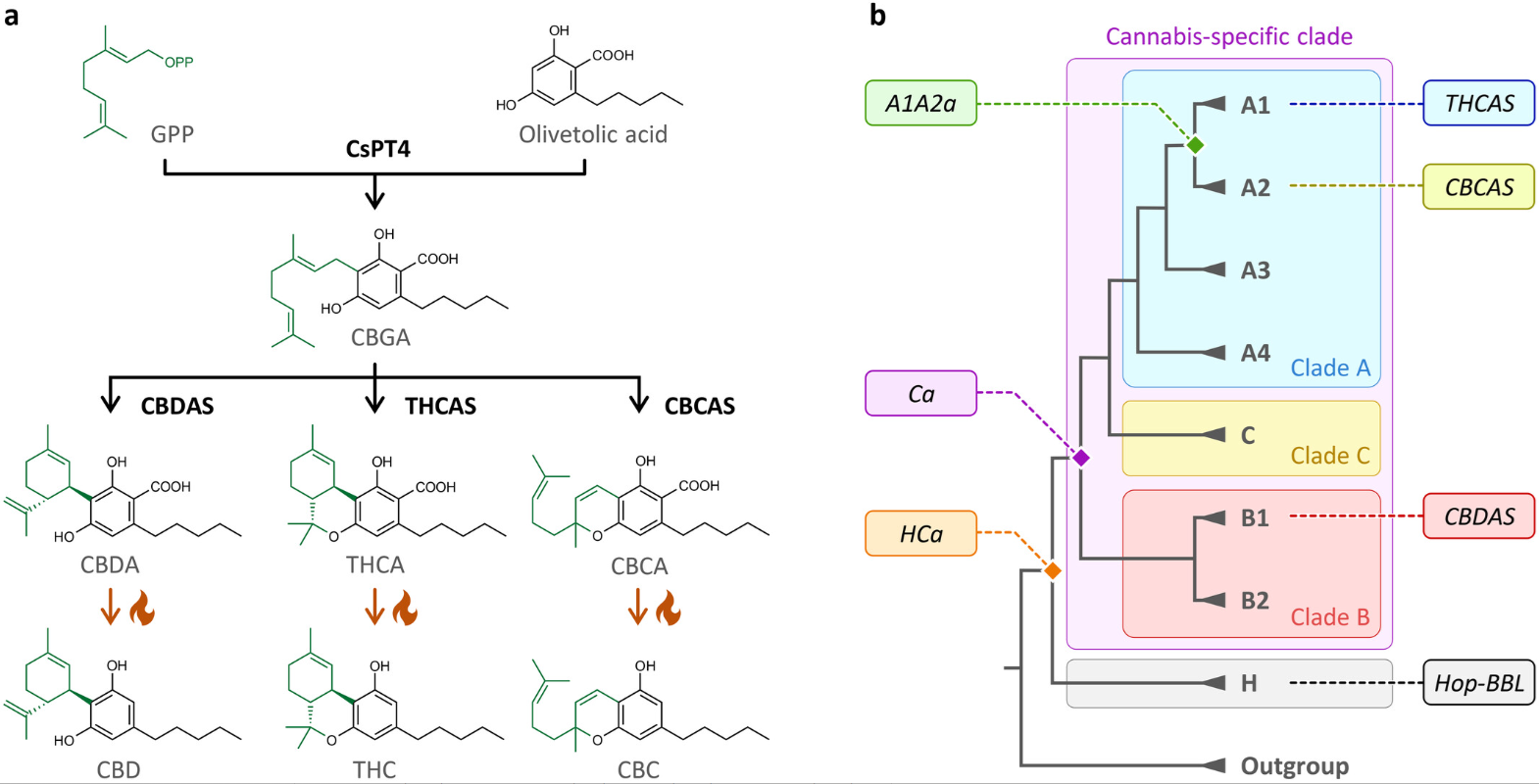
Cannabinoid biosynthesis in Cannabis sativa. (a) Cannabinoid biosynthesis pathway. Enzymatic reactions are symbolised with black arrows, nonenzymatic decarboxylations with orange arrows and delta symbols. (b) Simplified phylogeny of Berberine Bridge-Like (BBL) enzymes. Clades A (blue), B (red) and C (yellow) form the Cannabis-specific clade (purple), as defined previously (van Velzen and Schranz 2021). Clade H (grey) comprises uncharacterised C. sativa sequences as well as the Humulus lupulus sequence referred to as Hop-BBL. Extant THCAS, CBCAS, CBDAS and Hop-BBL genes are detailed on the right; internal nodes corresponding to ancestral A1A2a, Ca and HCa are on the left. Abbreviated molecules: CBC, cannabichromene; CBCA, cannabichromenic acid; CBD, cannabidiol; CBDA, cannabidiolic acid; CBGA, cannabigerolic acid; FAD, flavin adenine dinucleotide; GPP, geranyl pyrophosphate; THC, (−)-trans-Δ9-tetrahydrocannabinol; THCA, (−)-trans-Δ9-tetrahydrocannabinolic acid. Abbreviated enzymes: CBCAS, CBCA synthase; CBDAS, CBDA synthase; CsPT4, C. sativa prenyltransferase 4; THCAS, THCA synthase.
Cannabinoid oxidocyclases are members of the Berberine Bridge-Like (BBL) enzyme family (Sirikantaramas et al. 2004; Taura et al. 2007), known for catalysing chemically challenging oxidoreductions via bi-covalent attachment to their flavin adenine dinucleotide (FAD) cofactor (Daniel et al. 2017). Over the past 20 years, cannabinoid oxidocyclase enzymes have been investigated through targeted mutagenesis and crystallisation experiments. This led to the identification of residues involved in catalysis, substrate or FAD binding (Sirikantaramas et al. 2004; Taura et al. 2007; Shoyama et al. 2012; Zirpel et al. 2018; Villard et al. 2023; Dai et al. 2024), and to the proposal of catalytic mechanisms for CBGA conversion into THCA (Shoyama et al. 2012; Villard et al. 2023). Despite these valuable advances, it is still unclear how exactly cannabinoid oxidocyclases interact with CBGA and what controls their product selectivity, meaning that key residues are yet to be identified.
More recently, comparative genomics has revealed that the THCAS, CBDAS and CBCAS genes originated from recent gene duplications within the Cannabis lineage, thus forming a cannabis-specific clade (Figure 1b) that is absent from Humulus lupulus L. (hop), a close cannabis relative (Vergara et al. 2019; van Velzen and Schranz 2021). This cannabis-specific clade comprises three main clades (A–C) and seven subclades (A1–A4, B1–B2, C) (van Velzen and Schranz 2021). THCAS and CBCAS belong to subclades A1 and A2, respectively, and share 96% nucleotide identity. CBDAS belongs to subclade B1 and shares 89% identity with clade A. Other subclades contain uncharacterised genes and pseudogenes. Interestingly, the sister of the cannabis-specific clade—hereafter referred to as clade H—comprises several cannabis sequences and a single uncharacterised hop gene (van Velzen and Schranz 2021), referred to as Hop-BBL (Figure 1b). Given that all characterised enzymes from the cannabis-specific clade can metabolise CBGA, and that hop does not produce cannabinoids, it was previously hypothesized that CBGA metabolisation originated within the Cannabis lineage (Vergara et al. 2019; van Velzen and Schranz 2021). However, this has never been experimentally verified, meaning that the origin and functional evolution of cannabinoid oxidocyclases remain unknown.
To address this gap, we combined ancestral sequence reconstruction and heterologous expression to resurrect and characterise three ancestral cannabinoid oxidocyclases. Ancestor HCa was defined as the most recent common ancestor (MRCA) of clade H and the cannabis-specific clade; Ca as the MRCA of the cannabis-specific clade, and A1A2a as the MRCA of THCAS and CBCAS (Figure 1b). Characterising these ancestors confirmed that CBGA metabolisation originated in a recent ancestor of the cannabis Cannabis lineage and demonstrated that early cannabinoid synthases could produce all three THCA, CBDA and CBCA. We also engineered hybrid enzymes by swapping residues of ancestral and extant enzymes, thus highlighting key mutations underlying the emergence of CBGA metabolisation and subsequent subfunctionalisation toward highly-specialised THCAS and CBDAS. This work therefore contributes to the understanding of the functional evolution and molecular mechanism of cannabinoid oxidocyclases, which opens new perspectives for biotechnological uses.
2 Results
2.1 Reconstruction of Three Cannabinoid Oxidocyclase Ancestors
To reconstruct ancestral cannabinoid oxidocyclases, we selected 77 BBL sequences from cannabis, hop and Trema orientale (Data S1) and built a Bayesian gene tree (Figure S1), whose resulting topology was consistent with previous BBL classification (van Velzen and Schranz 2021). Internal nodes corresponding to ancestors A1A2a, Ca and HCa were identified and selected for ancestral sequence reconstruction (Figure S1). To ensure accuracy, each ancestral sequence was reconstructed four times, using Bayesian inference (nucleotide) and Maximum Likelihood (nucleotide, codon, amino acid models, Table S1, Data S2). The Bayesian-inferred sequences, which shared over 99% identity with the Maximum Likelihood nucleotide ones, were selected as the most robust sequences. Average posterior probability was 0.96 for A1A2a, 0.95 for Ca and 0.94 for HCa, indicating overall high confidence. Nucleotides associated with the lowest posterior probabilities were carefully analysed and manually curated (Table S1, Data S3). The final A1A2a sequence shared ≈97% nucleotide identity with THCAS and CBCAS. Ca shared 93%–95% identity with THCAS, CBCAS and CBDAS. HCa shared 81%–82% identity with THCAS, CBCAS and CBDAS, and 88%–91% identity with clade H. Comparison of homologous genome sequences from cannabis and hop (Figure S2) revealed that most cannabinoid synthase genes and closely related BBLs are part of a large syntenic block that is conserved in both species, confirming that they result from local gene duplications.
2.2 Resurrection of Ancestral Enzymes Reveals the Origin and Specialisation of Cannabinoid Synthases
The coding sequences of ancestral A1A2a, Ca, HCa and extant THCAS, CBDAS and Hop-BBL were domesticated (Data S4), synthesised, and expressed in yeast (Komagataella phaffii). Associated enzymes were purified and used for in vitro activity assays. To test whether these enzymes could metabolise CBGA, we first performed qualitative assays. Results showed that the THCAS and A1A2a enzymes could convert CBGA into THCA and CBCA, while the CBDAS and Ca enzymes produced THCA, CBCA and CBDA (Figure 2a). A1A2a and Ca also yielded traces of an unknown product, eluted at ≈16 min. This product was too close to the detection limit to be quantified and will not be further mentioned. To the contrary, Hop-BBL and HCa did not convert CBGA into any detectable product (Figure 2a) despite being properly expressed in our yeast system (Figure S3). This demonstrates that the ability to metabolise CBGA emerged along the branch leading from HCa to Ca (summarised in Figure 2c).
[...]