

Source / Quelle: https://pmc.ncbi.nlm.nih.gov/articles/PMC5576600/

Human Metabolites of Cannabidiol: A Review on Their Formation, Biological Activity, and Relevance in Therapy
Abstract
Cannabidiol (CBD), the main nonpsychoactive constituent of Cannabis sativa, has shown a wide range of therapeutically promising pharmacological effects either as a sole drug or in combination with other drugs in adjunctive therapy. However, the targets involved in the therapeutic effects of CBD appear to be elusive. Furthermore, scarce information is available on the biological activity of its human metabolites which, when formed in pharmacologically relevant concentration, might contribute to or even account for the observed therapeutic effects. The present overview summarizes our current knowledge on the pharmacokinetics and metabolic fate of CBD in humans, reviews studies on the biological activity of CBD metabolites either in vitro or in vivo, and discusses relevant drug–drug interactions. To facilitate further research in the area, the reported syntheses of CBD metabolites are also catalogued.
Key words: : biological activity, cannabidiol, metabolites, pharmacokinetics, synthesis
Introduction
Cannabidiol (CBD; Fig. 1) is one of the chemically and phytogenetically related phenolic terpenes derived from hemp (Cannabis sativa L). It was first obtained in pure form in 1940 simultaneously from fiber-type American hemp1 and from psychotropic Egyptian hashish.2 The chemical structure of CBD was determined by Mechoulam and Shvo in 1963.3 CBD is one of the 142 phytocannabinoids that have been isolated so far from hemp.4 Strictly speaking, however, CBD is an artifact: the genuine natural product is cannabidiolic acid (CBDA; Fig. 1), which under the influence of heat is decarboxylated into CBD in the plant material. Likewise, another major phenolic terpene of hemp, Δ9-tetrahydrocannabinol (THC)5 is formed from the corresponding carboxylic acid (THCA; Fig. 1).
Although CBD was isolated and characterized first, THC has been investigated more thoroughly: THC is responsible for the unique psychoactivity of marijuana, or cannabis, which is an internationally controlled substance, nevertheless widely used for recreational purposes or, more recently, for self-medication.6 Synthetic THC has been available for three decades as a medicine, and pharmaceutical-grade herbal cannabis, as well as formulations of cannabis extracts containing THC and CBD in well-defined ratios, has also been registered as medicines in several countries (see chapters of Part 3 of Pertwee6). Due to its unique psychoactivity and therapeutic potential, both associated with the activation of cannabinoid (CB) receptors, as well as for forensic reasons, the pharmacokinetics and pharmacodynamics of THC is much better understood than those of the nonpsychoactive CBD, which for decades has been a neglected phytocannabinoid.
The chemistry and pharmacology of CBD, as well as the various molecular targets, including CB receptors and other components of the endocannabinoid system it interacts with, have adequately been reviewed,7–11 while the pharmacology of CBD analogs, with emphasis on anti-inflammatory effects, was the subject of a recent overview.12
In the recent decade, preclinical studies, human case reports, and a plethora of anecdotal accounts, recognizing the relative safety of CBD, have prompted the exploration of the therapeutic potential of CBD against a range of diseases.13–18 In particular, the promise of CBD in treating cancer and drug-resistant epilepsy in children has recently brought this natural product into the focus of the scientific community, clinicians, the media, as well as politicians and regulatory agencies.19–24 Consequently, the US Food and Drug Administration and the European Medicines Agency have granted CBD preparations the “Orphan Drug” designation for use in the treatment of epilepsy in children (Dravet and Lennox-Gastaut syndromes) and neonatal asphyxia, and clinical trials sponsored by GW Pharma Ltd. have been started in these indication areas.25,25a,25b
While some information on the pharmacokinetics of CBD in experimental animals and humans is available,26–29 the biological activity of CBD metabolites has received scant attention.30 The purpose of this review is to summarize our current knowledge of the human pharmacokinetics of CBD with particular emphasis on the biological properties of established or putative human metabolites of CBD. We also indicate several gaps in our knowledge on CBD metabolites, which should be filled by further research that aims to expand the therapeutic use of CBD-based medications. Forensic studies reporting on CB levels as detected in the urine, blood, or saliva of smokers of cannabis cigarettes or of users of various medicinal cannabis preparations have been excluded (for recent reviews, see Huestis28 and Huestis and Smith29). To facilitate further research in the area, the synthetic routes reported for CBD metabolites and their close structural analogs are also catalogued.
Human Pharmacokinetics of CBD Upon Various Administration Routes
Extensive studies in animals, including rodents and the dog, indicate that a large portion of the administered CBD is excreted intact or as its glucuronide.26,27 Due to extensive Phase I metabolism, the pharmacokinetics of CBD is complex and the bioavailability of oral CBD is low across species.26–29 In general, the most abundant metabolites are hydroxylated 7-COOH derivatives of CBD (Fig. 2) that are excreted either intact or as glucuronide conjugates. The route of administration affects the pharmacokinetics of CBD and high intra- and intersubject variability is common in humans as the following paragraphs demonstrate.
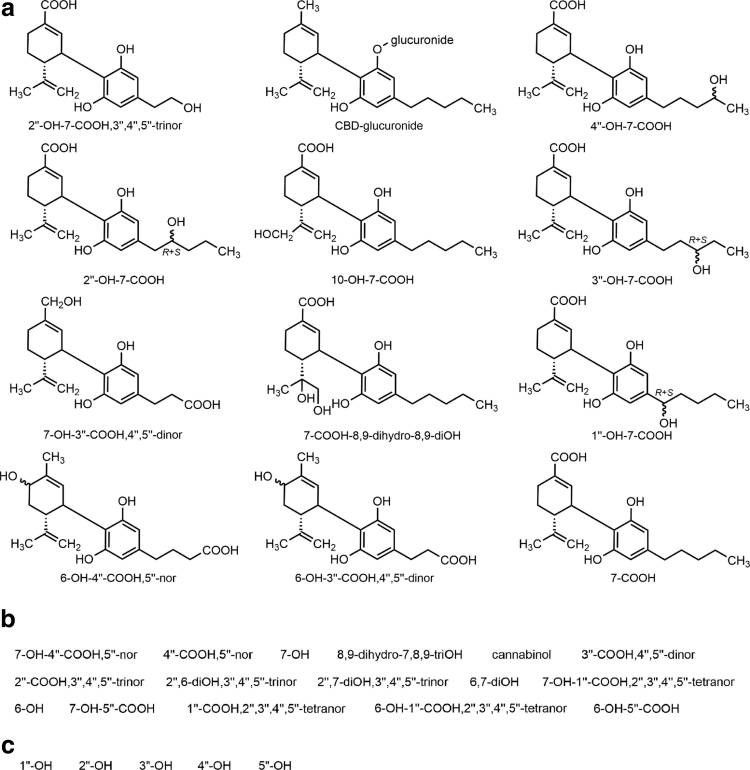
[...]
CBD-derived and metabolite-like substances
One of the interesting metabolites of CBD is cannabielsoin (Fig. 3), which was obtained first photochemically from CBD,65 and has not been isolated from humans but has been identified in guinea pigs.66,67 Furthermore, a hydroxyquinone derivative of CBD (HU-331; Fig. 3), which was again obtained first by synthesis,68 has been postulated to be a short-lived (re)active oxidative metabolite of CBD (see below).
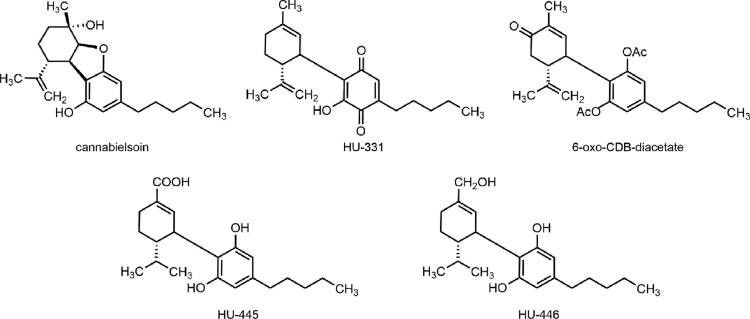
Recently, the side-chain hydrogenated form of the minor human metabolite 7-COOH-CBD, that is, 8,9-dihydro-7-COOH-CBD (HU-445; Fig. 3), has been synthesized.69 The dihydrogenated product of the minor human metabolite 7-OH-CBD, that is, 8,9-dihydro-7-OH-CBD (HU-446; Fig. 3) has also been prepared and found to have anti-inflammatory properties in vitro with negligible affinity toward CB1 and CB2 receptors.70
[...]