

Source / Quelle: https://www.mdpi.com/2076-3921/15/6/754
Abstract
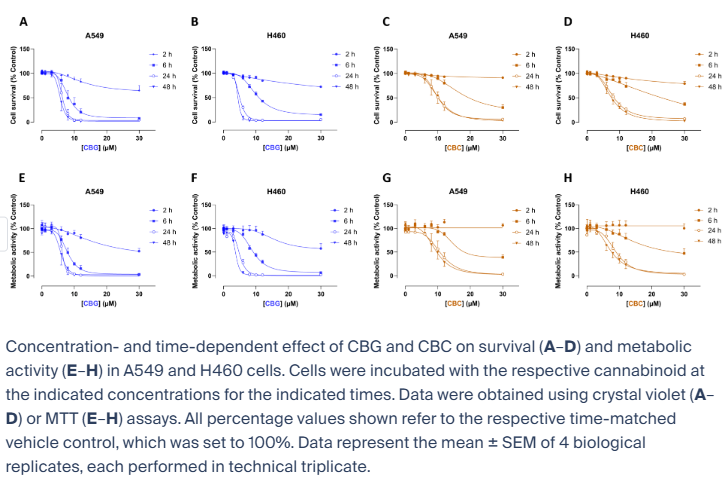
Cannabinoids are potential anticancer agents for the add-on treatment of malignant tumors. Here, the effects of the previously less-explored non-psychoactive phytocannabinoids cannabigerol (CBG) and cannabichromene (CBC) on survival, apoptosis, and mitochondrial function were assessed in A549 and H460 lung cancer cells. CBG and CBC triggered concentration-dependent cell death, autophagy, and mitochondrial apoptosis in both cell lines, with apoptosis indicated by Annexin V staining, activation of caspase-8, -9, and -3/7, loss of mitochondrial membrane potential, and elevated cytosolic levels of mitochondrial cytochrome c. CBG also upregulated ATF4, a stress-responsive transcription factor involved in autophagy and apoptotic signaling, and enhanced PARP cleavage. Both cannabinoids increased mitochondrial superoxide formation and reduced the mitochondrial oxygen consumption rate, with CBG additionally decreasing NDUFB8, a subunit of respiratory chain complex I. Pharmacological receptor modulation showed that CBG- and CBC-induced cell death occurred independently of CB1, CB2, TRPV1, TRPM8, and PPARγ, whereas CBG-mediated cell death relied on PPARα, which also contributed to its apoptotic effects. In summary, CBG and CBC induce apoptosis and cell death in A549 and H460 cells, with PPARα mediating the effects of CBG, highlighting its potential as a therapeutic target.
Keywords:
cannabigerol; cannabichromene; lung cancer; peroxisome proliferator-activated receptor α; cell death; apoptosis; mitochondrial dysfunction
1. Introduction
There is now substantial preclinical evidence supporting an anticancer action of various cannabinoids in different tumor entities. This effect extends to inhibition of tumor cell proliferation, angiogenesis, invasion and metastasis, as well as induction of apoptosis and autophagy (for reviews, see [1,2]). In addition, synergy between cannabinoids and established chemotherapeutics at the level of tumor cell proliferation and apoptosis was demonstrated in many cases (for review, see [3]). In accordance with this, a first randomized phase Ib clinical study showed that adding nabiximols, an extract containing roughly equal amounts of Δ9-tetrahydrocannabinol (THC) and cannabidiol (CBD), to existing chemotherapy resulted in an increase in survival time in patients with recurrent glioblastoma [4].
Two of the less well-researched phytocannabinoids, in comparison to THC and CBD, are the non-psychoactive representatives cannabigerol (CBG) and cannabichromene (CBC). The monocyclic CBG was first isolated by Gaoni and Mechoulam in 1964 [5] and was considered the missing link in the biosynthesis of THC. In 1971, it was synthesized de novo by its discoverers [6]. CBC, a structurally diverse bicyclic cannabinoid, was identified in 1966 [7] and, along with THC, is one of the most abundant phytocannabinoids. CBG and CBC interact with the endocannabinoid system in different ways. CBG has been shown to display a weak binding affinity to the cannabinoid receptors CB1 and CB2 [8,9], but to be the most potent phytocannabinoid ligand at the transient receptor potential vanilloid 1 (TRPV1) channel [10]. Furthermore, CBG is a potent antagonist of TRPM8 [11] and transcriptionally activates peroxisome proliferator-activated receptor (PPAR) α [12]. CBC also displays CB1 and CB2 affinities [13], exhibits selectivity and high efficacy at the CB2 receptor [14], and activates TRPA1 [11].
As early as 2006, Ligresti et al. reported in vitro anticancer effects of CBG and CBC [15]. However, despite corresponding efforts for CBG (for review, see [16]), the mechanistic basis of the tumor cell death-inducing effect of both cannabinoids was less investigated than that of other phytocannabinoids such as CBD. In particular, the PPARα-activating property of CBG has not been considered in the context of cancer so far. Remarkably, several findings published in recent years have demonstrated that activation of the transcription factor PPARα in cancer cells is associated with antiproliferative [17], cytotoxic [18,19], pro-apoptotic [20], and mitochondrial dysfunction-promoting [20,21] effects. On the other hand, several studies have also shown that antagonists of PPARα possess an antiproliferative, viability-reducing or pro-apoptotic action on tumor cells [22,23,24,25]. In fact, due to their relationship with tumor metabolism, the genes regulated by PPARα can mediate cancer-promoting or cancer-inhibiting effects (for review, see [26]), making PPARα a complex target and offering therapeutic potential for both agonists and antagonists of this receptor.
This study investigates the effects of CBG and CBC on lung cancer cell survival, apoptosis, and mitochondrial function and bioenergetics, with particular emphasis on the role of PPARα in this process. Here, we show convincing cytotoxic, pro-apoptotic and mitochondrial toxic effects of both cannabinoids. More importantly, this study demonstrates for the first time a mediating role of PPARα in the induction of tumor cell death and apoptosis by CBG, which makes this non-psychoactive phytocannabinoid an interesting compound in the search for new targeted therapies for the treatment of malignant tumors.
2. Materials and Methods
2.1. Materials
Cannabigerol (CBG, #15293), (±)-cannabichromene (CBC, #ISO60163), AM251 (#71670), AM630 (#10006974), GW6471 (#11697), and GW9662 (#70785) were obtained from Cayman Chemical (Ann Arbor, MI, USA). Capsazepine (#C191) was obtained from Sigma-Aldrich (Taufkirchen, Germany). Icilin (#1531) and WS12 (#3040) were purchased from Tocris (Bristol, UK). Etomoxir (#HY-50202; MedChem Express, Monmouth Junction, NJ, USA) and NXT629 (#HY-114263; MedChem Express, Monmouth Junction, NJ, USA) were obtained from Hölzel Diagnostika Handels GmbH (Cologne, Germany). Leupeptin was bought from Biomol (Hamburg, Germany). Acetic acid, dimethyl sulfoxide (DMSO), ethylenediaminetetraacetic acid (EDTA), glycerol, hydrochloric acid (HCl, 37%), sodium chloride (NaCl), sodium hydroxide (NaOH), and Tris hydrochloride (Tris-HCl) were obtained from AppliChem (Darmstadt, Germany). Aprotinin, bromophenol blue, hydrogen peroxide solution (H2O2, 30%), luminol, orthovanadate, p-coumaric acid, thiazolyl blue tetrazolium bromide (MTT), and phenylmethanesulfonyl fluoride (PMSF) were obtained from Sigma-Aldrich (Taufkirchen, Germany). Methanol was purchased from J. T. Baker (Griesheim, Germany), ethanol from Walter-CMP (Kiel, Germany), and aqua ad iniectabilia from B. Braun Melsungen (Melsungen, Germany). 4-(2-hydroxyethyl)-1-piperazineethanesulfonic acid (HEPES) and β-mercaptoethanol were obtained from Ferak Berlin (Berlin, Germany). Acrylamide (Rotiphorese® Gel, 30%), ammonium peroxydisulphate (APS), crystal violet, glycine, non-fat milk (NFM), Ponceau S, sodium dodecyl sulfate (SDS) ultrapure, Tris ultrapure, N,N,N′,N′-tetramethylethylenediamine (TEMED), Triton® X-100, and Tween® 20 were purchased from Carl Roth (Karlsruhe, Germany). Bovine serum albumin (BSA) was obtained from SERVA (Heidelberg, Germany). Dulbecco’s phosphate-buffered saline (DPBS, #P04-36500), fetal bovine serum (FBS, #P30-3306) and High Glucose Dulbecco’s Modified Eagle Medium (DMEM, #P04-04510) were obtained from PAN-Biotech (Aidenbach, Germany). Penicillin-streptomycin (#15140-122) and 0.5% Trypsin-EDTA (#15400-054) were purchased from Thermo Fisher Scientific (Schwerte, Germany).
[...]